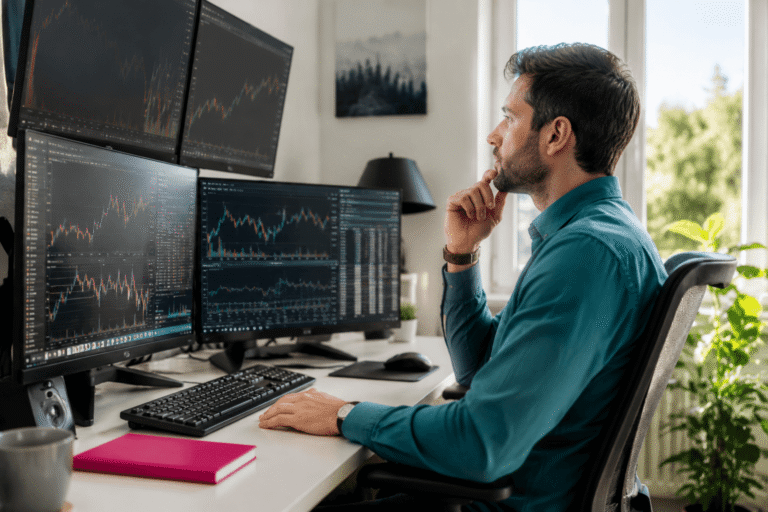

When traders face drawdowns that are larger or more prolonged than expected, the emotional impact often reaches deeper than the effect on the account. A drawdown can feel like a challenge to personal judgment, strategy competence, and long‑term viability. Especially for traders who have spent years honing their skills, a sequence of losing trades can shake core confidence and lead to what the industry increasingly recognizes as loss of self-trust trading.
This isn’t about lack of intelligence or poor strategy. It is about how the internal belief system responds when repeated losses collide with identity, confidence, and self‑perception. Hypnosis works directly with those internal patterns by helping the subconscious mind rebalance beliefs about ability, risk, and personal value.
Below you will learn why self‑trust erodes after drawdowns, how that erosion affects trading behavior, and how targeted hypnosis can help rebuild a stable sense of internal confidence.
Jump To:
TLDR Quick Guide
- Why self‑trust declines after drawdowns: Traders often interpret losses as personal failure instead of strategy feedback, which undermines internal confidence and clear decision making.
- Why this matters: Self‑trust fuels discipline, execution, and consistent performance. Without it, hesitation, second‑guessing, and emotional judgment create trouble with trading.
- How hypnosis supports recovery: Hypnosis works with subconscious beliefs so traders can separate identity from outcomes, rebuild internal confidence, and reduce emotional interference in decisions.
- Who can benefit: Any trader who has lost confidence after a losing period and wants to restore clarity, calm, and effective execution.

What Happens to Self-Trust After Drawdowns
Understanding the Internal Shift
When a trader experiences a drawdown, the first impact is numerical — dollars gone, percentages down. The second impact, and often the deeper one, is internal — emotions and narratives about capability, control, and worth are activated. This is especially true when the trader believes their value is tied to how well trades perform.
Instead of seeing a drawdown as natural feedback about a specific position or risk model, the mind often interprets it as a judgment about ability, skill, or self‑worth. This internal interpretation then influences future decisions. Confidence weakens, hesitation increases, and clarity gives way to doubt.
For example, a trader who trusted their system moments before a drawdown might experience a sudden internal shift toward doubt:
- “Maybe this system does not work.”
- “Am I cut out for this?”
- “I should have known better.”
Those kinds of internal narratives can become louder than the strategy itself. The mind shifts away from analysis to internal evaluation, and that shift undermines self‑trust.
The Effect on Decision Making
Once self‑trust is weakened, decision making becomes less reliable. Traders may:
- Delay entries because they fear being wrong again
- Shift too quickly to new strategies before the current one is fully evaluated
- Over‑trade in an attempt to “prove” ability
- Trade as revenge to make up for losses
- Avoid trades entirely
These behavioral changes are not about strategy. They are about the internal state that drives execution. External behaviors are driven by internal emotions.
Self‑trust influences how you trade. When it is damaged by emotional reactions to drawdowns, execution becomes shaky instead of steady.
How Hypnosis Supports Rebuilding Self Trust
Hypnosis works by accessing the deeper internal belief systems — the ones that operate below conscious reasoning and influence emotional and decision patterns. Rather than forcing conscious willpower to “just be confident,” hypnosis helps shift how the subconscious interprets experiences and stores internal narratives.
Here’s how that process works in the context of trading:
1. Calming Internal Reactions to Loss
Losses can trigger internal alarms that heighten emotional reactions like fear, frustration, or self‑criticism. Hypnosis helps calm that internal alarm response so the system does not remain on high alert.
A calmer internal system gives you:
- More space to assess decisions rationally
- Less emotional urgency that clouds judgment
- A stable internal baseline from which to think strategically
This emotional regulation aspect is at the heart of Hypnosis for Stock Traders. When the subconscious no longer overinterprets a drawdown as personal threat, the trader can approach the next trade with steadier confidence.
2. Strengthening Internal Belief in Ability
After losses, self‑doubt often creeps in. Instead of “I can trust my analysis,” the inner voice shifts to “What if I fail again?” These loops are not strategic problems — they are internal belief patterns that govern how the mind reacts under pressure.
Hypnosis helps reinforce internal messages that:
- Recognize skills and preparation
- Separate temporary outcomes from personal value
- Restore trust in the internal decision‑making process
Both Self‑Confidence Hypnosis and Confidence‑Building Hypnotherapy support this internal restoration by reinforcing positive language and internal frameworks based on capability instead of outcome.
Over time, these internal cues become default subconscious references — strengthening your internal compass.
3. Shifting Internal Narratives About Loss
A drawdown can trigger narratives such as:
- “I should have known better”
- “I am not as skilled as I thought”
- “Things never work out for me”
These narratives override conscious logic and become internal signals that weaken self‑trust. Hypnosis helps rewrite those subconscious stories so the mind interprets:
- Losses as feedback and data instead of judgments
- Experiences as learning opportunities instead of proof of inability
- Strategy as process‑driven instead of ego‑driven
This reframing is key to long‑term control over emotional reactions in trading.
4. Addressing Internal Doubt After Setbacks
Many traders hear an internal voice after losses like “Maybe I never knew what I was doing.” Internal doubt of this nature doesn’t come from rational analysis — it comes from subconscious misinterpretation of events.
Hypnosis such as Imposter Syndrome Hypnotherapy or Overcome Imposter Syndrome specifically addresses this narrative. It helps the mind move away from internal judgments of fraudulence or unworthiness and strengthens the sense that capability is not erased by temporary outcomes.
When internal doubt decreases, decision confidence rises — and that confidence is rooted in self‑trust, not ego.
What Changes After Hypnosis Work
Before Hypnosis
Internal experience after a drawdown might include:
- Repetitive self‑questioning
- Fear of repeating mistakes
- Hesitation in decision making
- Emotional noise that interferes with execution
After Hypnosis
Internal experience becomes:
- Emotionally calm in the face of setbacks
- Confident in decision‑making frameworks
- Future‑focused rather than retrospective
- Strategic instead of reactive
Hypnosis doesn’t remove ambition or critical thinking. It clears the internal fog so your strategy, knowledge, and preparation can operate without interference from emotional noise.
Key Takeaways
- Loss of self trust trading often happens when internal belief systems interpret drawdowns as personal failure rather than feedback.
- Hypnosis works with the subconscious mind to calm internal emotional reactions, rebuild confidence in decision‑making, and shift internal narratives that weaken self‑trust.
- Services such as Hypnosis for Stock Traders, Self‑Confidence Hypnosis, Confidence‑Building Hypnotherapy, and Imposter Syndrome Hypnotherapy all support stronger internal belief systems for consistent performance.
- With self‑trust restored, traders can execute strategy with focus and confidence, view outcomes as information not judgment, and remain resilient in the face of volatility.
FAQs About Loss of Self Trust Trading and Hypnosis
How does hypnosis for stock traders help rebuild confidence after a drawdown?
It helps restructure subconscious interpretations of losses so internal self‑trust is not shaken by temporary performance outcomes, allowing decisions to be made from clarity rather than fear.
Can self‑confidence hypnosis help traders stop second‑guessing after losing trades?
Yes. It strengthens internal belief in your decision‑making process so hesitation based on past losses declines and confidence in execution increases.
How does confidence‑building hypnotherapy support traders who lost trust in strategy?
It reinforces internal signals of competence, resilience, and focus so traders can reapply their strategy without internal pressure compounding hesitation.
Can imposter syndrome hypnotherapy reduce the feeling of “I must not belong here” after setbacks?
Yes. It helps shift internal narratives of unworthiness or fraudulence so your self‑trust is not dependent on short‑term trading results.
Is hypnosis only helpful for traders who just lost big, or can it help anyone who lost confidence?
It can help any trader whose internal confidence has been affected by performance results, whether from a single setback or a series of smaller losses.
Disclaimer
While hypnosis has many scientifically documented beneficial effects, it is not a substitute for medical, psychological, or psychiatric treatment. We are not licensed mental health practitioners, and do not claim to diagnose, treat, cure, or prevent any disease or illness. Please seek care from a licensed mental health professional or medical doctor for these purposes. This article is for informational purposes only and is not meant to provide medical or mental health advice. All terms are used as common vernacular rather than diagnostic language. No promise of income is being made in this article or for any services being offered.