

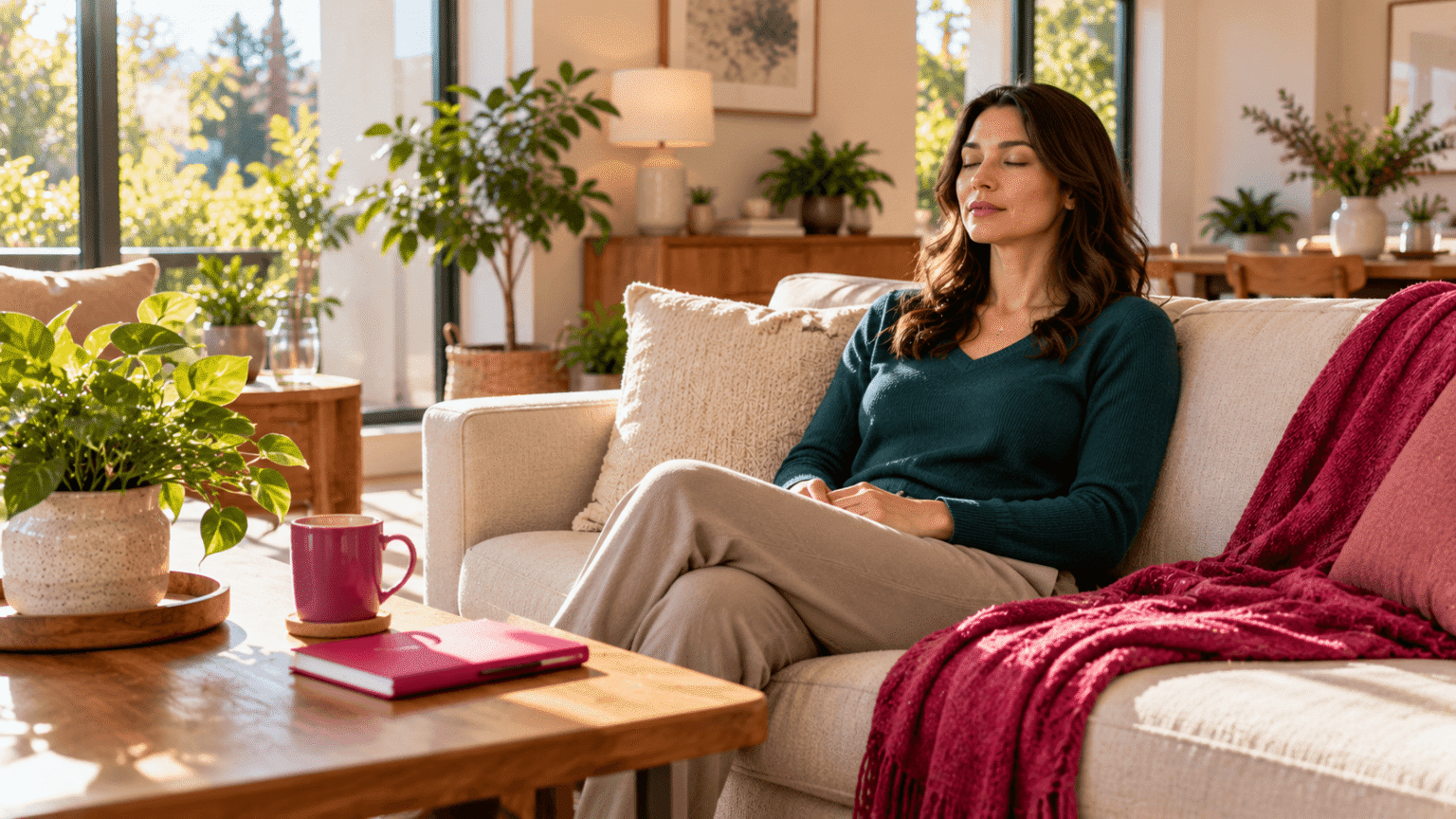
Have you ever come home after a long day, sat down to relax, and discovered that your mind is still working overtime? Maybe you’re thinking about tomorrow’s responsibilities, replaying a conversation, or worrying about everything you haven’t finished. If you’ve been wondering, can self-hypnosis help with daily stress at home? The answer is that it may offer a simple way to practice relaxation, focus your attention, and explore a calmer response to everyday pressures.
Imagine finally getting a few quiet minutes to yourself.
You’ve finished dinner. The dishes are done. You’re sitting comfortably on the couch.
But instead of enjoying the moment, your mind starts reminding you about:
- The email you forgot to answer
- The bills you need to pay
- The conversation that didn’t go as planned
- The responsibilities waiting for you tomorrow
- The things you wish you’d done differently today
Sound familiar?
Here’s something I invite you to consider.
What if relaxing isn’t only about having fewer things to do? What if it’s also about learning how to respond differently to the thoughts running through your mind?
You see, your mind can develop habits just as your body does. If you’ve spent years worrying, rushing, or expecting problems, those patterns may begin to feel automatic.
The good news is that you can explore different ways of using your attention.
Self-hypnosis is one approach that may help you practice slowing down, imagining more comfortable experiences, and becoming more aware of your thoughts.
And you don’t need a special room, expensive equipment, or an entire afternoon to begin.
Let’s explore how self-hypnosis works, why daily stress can follow you home, and what you can practice to make relaxation a more familiar part of your routine.
TLDR Quick Guide: Self-Hypnosis for Everyday Stress
Self-hypnosis is a practice that uses focused attention, relaxation, and mental suggestions to explore how you think and respond. It may be useful when everyday responsibilities leave you feeling mentally busy, even after you’ve finished your tasks.
Here’s what I want you to know:
- Self-hypnosis is something you practice yourself. You guide your attention using relaxation, imagery, or simple suggestions.
- You remain aware and in control. You can stop the exercise whenever you choose.
- Stress can become a familiar thinking pattern. Your mind may continue reviewing responsibilities even when you’re ready to rest.
- You don’t need a perfect environment. A quiet, comfortable space is a helpful starting point.
- Small sessions can be practical. You can begin with a few minutes rather than setting aside a long period.
- Mental imagery may support relaxation. Imagining a peaceful setting can give your attention something different to focus on.
- Self-hypnosis doesn’t remove life’s responsibilities. It may help you practice responding to them more thoughtfully.
- Results vary. Some people find the practice useful, while others prefer different relaxation approaches.
The purpose isn’t to force your mind to become completely quiet. Instead, you can practice noticing your thoughts without automatically following every worry that appears.
Jump to Sections
- What Is Self-Hypnosis, and How Does It Work?
- Why Does Daily Stress Follow You Home?
- How Can Self-Hypnosis Help With Daily Stress at Home?
- How to Practice Self-Hypnosis at Home
- Five Everyday Situations Where Self-Hypnosis May Be Useful
- How to Build a Self-Hypnosis Routine That Fits Your Life
- When Might Guided Hypnosis and Coaching Be Worth Exploring?
- Key Takeaways
- Frequently Asked Questions
What Is Self-Hypnosis, and How Does It Work?
Let’s start with something simple.
Have you ever become so interested in a book or movie that you temporarily forgot about everything happening around you?
You were still awake.
You could have stopped reading or watching whenever you wanted.
But your attention was focused on one experience.
Self-hypnosis involves a different kind of focused attention, often combined with relaxation and guided imagination.
Self-Hypnosis Is About Focused Attention, Not Losing Control
Some people imagine hypnosis as something mysterious.
Maybe they’ve seen a stage performance where someone appears to follow unusual instructions.
But that’s not the way I want you to think about self-hypnosis.
During a typical self-hypnosis exercise, you intentionally guide your attention toward something you’ve chosen.
That might involve:
- Focusing on your breathing
- Relaxing different parts of your body
- Imagining a comfortable or peaceful setting
- Repeating a helpful statement
- Mentally rehearsing how you’d like to approach a situation
- Noticing thoughts without immediately reacting to them
You remain an active participant.
You can open your eyes, change your position, or stop whenever you want.
And you don’t need to reach some mysterious state for the practice to be meaningful.
The important part is giving yourself an opportunity to focus in a different way.
Think of Your Mind Like a Computer Running Too Many Programs
Here’s an analogy I like.
Imagine your computer has twenty programs running at the same time.
One is checking email.
Another is playing music.
Several others are downloading updates in the background.
Eventually, the computer may seem slower because so many things are demanding attention.
Your mind can feel similar.
You might be physically sitting at home while mentally reviewing work, family responsibilities, money concerns, and tomorrow’s schedule.
It’s as though all those programs are still running.
Self-hypnosis doesn’t magically close every program.
But it may give you an opportunity to focus on one experience instead of trying to pay attention to everything at once.
For example, you might spend a few minutes imagining a peaceful place rather than reviewing your unfinished tasks.
That’s one reason people explore guided relaxation for well-being as part of their personal routines.
The goal isn’t to avoid responsibility. It’s to create moments when your attention isn’t constantly pulled in different directions.
Why Does Daily Stress Follow You Home?
Have you ever noticed that finishing your work doesn’t always mean your mind is finished thinking about it?
Maybe you’ve closed your laptop, but you’re still planning tomorrow’s meeting.
Perhaps you’re preparing dinner while thinking about an uncomfortable conversation.
Or you’re trying to enjoy time with your family, but your thoughts keep returning to your responsibilities.
Why does that happen?
Sometimes, the mind develops habits of planning, reviewing, and anticipating problems.
Your Mind May Have Learned to Stay Busy
Think about how often you remind yourself to stay productive.
You may tell yourself:
- “I can’t forget anything.”
- “I need to stay ahead.”
- “There’s always something else to finish.”
- “I should be doing something useful.”
- “If I relax, I’ll fall behind.”
These thoughts may seem helpful when you’re trying to complete important tasks.
But what happens when the workday ends?
You might still feel as though you should be doing more.
Over time, being busy can become such a familiar pattern that resting feels uncomfortable.
When exploring stress and burnout challenges, it can be useful to consider not only your responsibilities but also the expectations you place on yourself.
Sometimes, the question isn’t simply, “How can I finish everything?”
It may also be, “How can I give myself permission to pause when I’ve done what I reasonably can?”
Your Imagination May Keep Replaying the Day
Let’s say you had an uncomfortable conversation with a coworker.
The conversation ended hours ago.
You’re now sitting at home.
But your mind keeps returning to what happened.
You might think:
“I should have said something different.”
“Maybe they misunderstood me.”
“What if this becomes a problem tomorrow?”
Now imagine that you’re watching the same movie scene repeatedly.
Each time, you focus on what went wrong or what might happen next.
Your imagination can create a similar experience when you repeatedly review uncomfortable situations.
And sometimes, that mental replay makes it difficult to enjoy what’s happening right now.
This is where becoming aware of anxiety and overthinking patterns may be useful.
You don’t necessarily need to solve every thought the moment it appears.
Sometimes, you can notice the thought, decide whether it needs attention now, and return to what you’re doing.
Your Home May Have Become Another Place for Responsibilities
Here’s another possibility.
Maybe home doesn’t feel relaxing because there’s always something waiting for you.
You finish your job, then begin your second list of tasks.
There may be:
- Meals to prepare
- Laundry to finish
- Children or relatives who need attention
- Household expenses to organize
- Appointments to schedule
- Personal responsibilities you’ve been putting off
These are real responsibilities, not imaginary problems.
Self-hypnosis won’t wash the dishes or create extra hours in your day.
But it may provide a short opportunity to practice relaxation between activities.
And sometimes, giving yourself a few minutes of focused attention can be a more realistic goal than expecting an entire evening without interruptions.
How Can Self-Hypnosis Help With Daily Stress at Home?
Now let’s return to our main question.
Can self-hypnosis help with daily stress at home?
It may help some people practice relaxation, shift their attention away from repetitive worries, and mentally rehearse more thoughtful responses to familiar situations.
That doesn’t mean stress disappears or that self-hypnosis works the same way for everyone.
Instead, I encourage you to think of it as a skill you can explore and practice.
1. Practice Moving Your Attention Away From Constant Worry
Imagine you’re sitting on your couch after dinner.
Your mind starts thinking about tomorrow.
You remember an unfinished task.
Then another.
Soon, you’re mentally back at work.
During self-hypnosis, you can practice directing your attention toward something you’ve chosen.
For example, you might focus on:
- The feeling of your feet resting on the floor
- The gentle movement of your breathing
- The sound of a quiet room
- An imagined peaceful outdoor setting
- A simple statement about taking a moment to rest
Your thoughts may still wander.
That’s normal.
When you notice your attention moving back toward your responsibilities, you can gently return to your chosen focus.
The purpose isn’t to win a battle against your thoughts.
It’s to practice guiding your attention without criticizing yourself whenever your mind becomes busy.
2. Explore the Belief That You Must Always Be Productive
Here’s something I’d like you to consider.
Do you ever feel guilty when you’re not doing something useful?
Maybe you sit down for a few minutes and immediately think about everything you should be finishing.
You might even believe that resting means you’re being lazy.
But is that always true?
During self-hypnosis, you may choose to explore a different idea.
For example:
- “I can take a break without ignoring my responsibilities.”
- “Rest is a reasonable part of my day.”
- “I don’t have to complete every task before allowing myself to pause.”
- “I can return to my responsibilities after giving myself a moment.”
- “My value isn’t measured only by how much I accomplish.”
These aren’t statements you must force yourself to believe.
Instead, they’re ideas you can consider.
You may discover that some of your expectations about productivity deserve a second look.
3. Mentally Rehearse a More Thoughtful Response
Let’s imagine a familiar situation.
You arrive home after a busy day.
Someone asks you to handle another responsibility.
Normally, you might feel frustrated and respond sharply.
Now consider what you’d prefer to do.
Perhaps you’d like to pause, listen, and explain what you can realistically manage.
During self-hypnosis, you could imagine yourself:
- Hearing the request without answering immediately
- Taking a moment to understand what’s being asked
- Considering your available time and energy
- Communicating your limits respectfully
- Deciding what needs attention now and what can wait
Notice that we’re not pretending the responsibility disappears.
We’re exploring how you’d like to participate in the situation.
This type of mental rehearsal may be useful when practicing everyday communication and decision-making.
Through stress reduction hypnotherapy, we may explore similar patterns using guided hypnosis and personal-development coaching.
4. Create a More Comfortable Transition Between Activities
Have you ever gone directly from a stressful workday into household responsibilities without taking a moment to pause?
Maybe you finish your last meeting and immediately start preparing dinner.
Or you close your laptop and begin answering family messages.
Your schedule changes, but your attention may still be focused on work.
A short self-hypnosis practice could become part of your transition.
For example, you might:
- Finish your work responsibilities for the day
- Move to a quiet, comfortable place
- Spend several minutes practicing focused relaxation
- Imagine leaving unfinished work concerns for tomorrow
- Choose one simple activity to begin your evening
This doesn’t mean you’ll forget important responsibilities.
You can write down anything that needs attention later.
The purpose is to create a clear moment between one part of your day and the next.
Exploring work-life balance through hypnosis may also help you consider the habits and expectations that make it difficult to disconnect from work.
How to Practice Self-Hypnosis at Home: A Simple Beginner Exercise
Now I’d like to invite you to try something practical.
You don’t need any previous experience with hypnosis.
You also don’t need to make yourself feel completely relaxed.
For this exercise, the goal is simply to practice focused attention and gentle mental imagery.
Choose a time when you can sit comfortably without needing to drive, supervise someone, operate equipment, or respond to anything requiring your full attention.
Step 1: Choose a Comfortable Place
Find somewhere you can sit without being interrupted for a few minutes.
It might be a chair in your bedroom, a quiet corner of your living room, or another comfortable space.
You don’t need special lighting or music.
Consider these simple preparations:
- Put your phone on silent if it’s safe to do so
- Choose a comfortable sitting position
- Loosen any clothing that feels restrictive
- Keep your feet supported
- Let others know you’d like a few quiet minutes
- Decide that you can stop whenever you choose
The goal isn’t to create a perfect environment.
It’s to make the experience comfortable enough that you can focus without unnecessary distractions.
If you hear a normal household sound, you don’t need to become frustrated.
You can simply notice it and return your attention to the exercise.
Step 2: Gently Focus on Your Breathing
Now allow your attention to settle on your breathing.
You don’t need to take unusually deep breaths or force a particular rhythm.
Simply notice the natural movement of breathing in and out.
As you sit, you might become aware of:
- Your feet resting on the floor
- Your hands resting comfortably
- Your shoulders moving gently
- The support of the chair beneath you
- The air moving naturally as you breathe
If you prefer, you can close your eyes.
If keeping them open feels more comfortable, that’s fine too.
You aren’t trying to achieve a special result.
You’re simply giving your attention something steady and familiar to notice.
Step 3: Imagine a Peaceful Place
Next, I’d like you to imagine somewhere you associate with comfort.
Maybe it’s a quiet beach.
Perhaps it’s a peaceful garden, a favorite room, or a place you’ve enjoyed visiting.
It doesn’t have to be somewhere you’ve actually been.
As you imagine the setting, consider:
- What colors would you see?
- What sounds might you hear?
- Would the air feel warm or cool?
- What would you notice around you?
- Where would you choose to sit or stand?
You don’t need to create a perfect picture.
Some people imagine clear images, while others think more about sounds, words, or general impressions.
Either approach is fine.
Spend a little time exploring the details that feel comfortable to you.
Step 4: Introduce a Helpful Suggestion
Now consider a simple statement that fits what you’d like to practice.
For example:
“I can give myself permission to pause.”
Or:
“I can focus on one thing at a time.”
You might also choose:
- “I can notice my thoughts without following everyone.”
- “I can return to my responsibilities when I’m ready.”
- “I can practice responding thoughtfully.”
- “I don’t need to solve everything right now.”
- “I can allow this moment to be a moment of rest.”
Choose a statement that feels reasonable.
You don’t have to repeat something you don’t believe.
If a suggestion feels uncomfortable or unrealistic, you can change it.
The purpose is to explore a more supportive way of directing your attention, not to pressure yourself into feeling a certain way.
Step 5: Return Your Attention to the Room
When you’re ready, begin noticing your surroundings again.
Feel the support of the chair.
Notice the sounds around you.
Move your hands or feet if that feels comfortable.
Then open your eyes if you’ve closed them.
Before continuing your day, take a moment to consider:
- What did I notice during the exercise?
- Which part felt most comfortable?
- Did my attention wander?
- Was there a suggestion I found useful?
- Would I like to try anything differently next time?
You don’t need to judge the experience as a success or failure.
Even if your mind wandered repeatedly, you had an opportunity to practice noticing and redirecting your attention.
And that’s a useful skill to explore.
Five Everyday Situations Where Self-Hypnosis May Be Useful
You might be wondering when to practice self-hypnosis.
Do you need to wait until you’re feeling overwhelmed?
Not necessarily.
You can explore it during ordinary parts of your day when you’d like to create a moment for focused relaxation.
Here are five situations to consider.
1. After Finishing Work
Imagine you’ve just closed your laptop.
Your workday is technically over, but your mind is still reviewing everything that happened.
You might be thinking about tomorrow’s schedule or a conversation you wish had gone differently.
Instead of immediately moving into another activity, you could give yourself a few minutes to pause.
You might use self-hypnosis to:
- Notice that your workday has ended
- Focus on your breathing
- Imagine setting unfinished tasks aside temporarily
- Consider what you’d like to do with your evening
- Return your attention to your home environment
Of course, some work concerns need practical action.
If there’s something important you might forget, write it down before beginning.
Then you can practice giving your attention to the next part of your day.
2. Before Starting Household Responsibilities
Let’s say you arrive home and see a long list of chores.
The kitchen needs cleaning.
Laundry is waiting.
Someone needs help with homework.
You may feel as though everything needs to happen immediately.
Here’s something to consider.
Could you give yourself a few minutes to decide what actually needs attention first?
A short self-hypnosis exercise may help you practice stepping away from the feeling that every task is equally urgent.
Afterward, you can choose one responsibility and begin there.
The purpose isn’t to avoid your chores.
It’s to approach them with a clearer sense of what you want to do next.
3. When Your Mind Keeps Replaying a Conversation
Have you ever spent an entire evening thinking about something someone said?
Maybe a coworker sounded irritated.
Perhaps a family member made a comment you didn’t like.
Or you keep wondering whether you handled a disagreement well.
You might find yourself mentally repeating the conversation.
If that happens, you could use a short relaxation exercise to redirect your attention.
For example:
- Notice the conversation you’re replaying
- Ask whether any action is needed right now
- Write down a concern if you want to revisit it later
- Choose a peaceful image to focus on
- Return to the activity you were doing
This doesn’t mean pretending the conversation never happened.
Sometimes, you may need to discuss the issue later.
But you don’t necessarily need to replay it repeatedly before deciding what to do.
Learning how to calm down when stressed may also involve recognizing when a thought needs practical attention and when you’re simply repeating the same concern.
4. During a Busy Weekend at Home
Weekends are supposed to be relaxing, right?
But sometimes, they become another list of responsibilities.
You might be shopping, cleaning, preparing meals, helping family members, and getting ready for the coming week.
Before you know it, Sunday evening has arrived.
You may wonder where your free time went.
Self-hypnosis could become a small part of your weekend routine.
For example, you might practice for a few minutes before beginning your morning activities or after completing an important task.
The goal isn’t to turn relaxation into another item you must accomplish perfectly.
It’s to make room for moments when you aren’t constantly planning your next responsibility.
5. When You’re Preparing to Wind Down for the Evening
Maybe you’ve finished everything you reasonably can for the day.
You’re ready to enjoy a quiet evening.
But your mind keeps returning to tomorrow.
You could use a gentle self-hypnosis exercise as part of your wind-down routine.
You might focus on:
- Sitting comfortably in a quiet space
- Allowing your breathing to remain natural
- Imagining a familiar peaceful setting
- Setting aside thoughts that can wait until tomorrow
- Returning your attention to the present moment
You don’t need to make falling asleep the goal.
Instead, think of the exercise as an opportunity to practice relaxation before continuing your evening routine.
If you experience persistent sleep problems, it’s important to seek appropriate professional guidance rather than relying on self-hypnosis alone.
How to Build a Self-Hypnosis Routine That Fits Your Life
Here’s something I’ve noticed about learning new skills.
Sometimes, people become so focused on doing everything correctly that they make the process more complicated than it needs to be.
They decide they must practice at exactly the same time every day.
They expect every session to feel wonderful.
And if they miss a day, they think they’ve failed.
But does learning something new really have to work that way?
I encourage you to approach self-hypnosis with curiosity rather than pressure.
Begin With a Manageable Amount of Time
You don’t need to set aside an hour.
You might begin with a few minutes when your schedule allows.
Consider these possibilities:
- A short practice after finishing work
- A quiet moment before beginning household chores
- A few minutes during an afternoon break
- A relaxation exercise before your evening routine
- A guided audio session when you have uninterrupted time
Choose something that fits your actual life.
If your schedule is unpredictable, you may prefer to practice whenever a suitable opportunity appears.
The important part is finding an approach you can explore comfortably.
Connect the Practice With an Existing Routine
Think about something you already do regularly.
Maybe you make a cup of tea after work.
Perhaps you sit in your favorite chair before dinner.
Or you spend a few quiet minutes in your bedroom before beginning your evening.
You could connect self-hypnosis with one of those familiar activities.
For example:
- Finish your workday and put away your laptop.
- Sit in your usual comfortable chair.
- Practice focused attention for a few minutes.
- Return your attention to the room.
- Decide what you’d like to do next.
This approach may make the practice easier to remember because it becomes connected with something you’re already doing.
You don’t need to create an entirely new schedule.
Use Guided Audio If You Prefer More Structure
Some people enjoy guiding themselves through an exercise.
Others prefer listening to instructions.
If you’re new to self-hypnosis, a guided recording may help you follow a simple sequence without having to remember every step.
You might choose an audio focused on:
- General relaxation
- Focused breathing
- Peaceful imagery
- Positive self-reflection
- Practicing helpful suggestions
At Silicon Valley Hypnosis Center, our free hypnosis resources offer a starting point for exploring available guided materials.
You can also learn more about hypnosis techniques for everyday anxiety if you’d like to understand different ways focused attention and imagery can be practiced.
Remember to use audio exercises only when you’re in a safe setting where you don’t need to concentrate on driving, operating equipment, or supervising someone.
Don’t Judge Every Session by How Relaxed You Feel
Here’s an important point.
Some days, you may find it easy to focus.
Other days, your mind may wander repeatedly.
You might feel comfortable during one exercise and restless during another.
That doesn’t automatically mean you’re doing something wrong.
Instead of asking, “Did I relax perfectly?” consider asking:
- Did I give myself time to practice?
- What did I notice about my thoughts?
- Was there anything I found helpful?
- Did I feel comfortable with the exercise?
- What would I like to try differently?
You may discover that some techniques suit you better than others.
And if self-hypnosis doesn’t feel useful, you can explore other approaches to relaxation.
The purpose is to find practices that support your goals, not to force yourself to enjoy a particular method.
When Might Guided Hypnosis and Coaching Be Worth Exploring?
You may be wondering whether you should continue practicing self-hypnosis on your own or explore a guided session.
That’s a reasonable question.
Self-hypnosis can be a personal practice, while working with a hypnosis practitioner may offer a more structured opportunity to explore your goals and familiar thinking patterns.
Neither approach guarantees a particular result.
When You Want Help Understanding Your Thinking Habits
Maybe you’ve noticed that your mind repeatedly returns to work concerns.
Perhaps you have difficulty taking breaks because you believe you must always be productive.
Or you want to explore why certain everyday situations feel especially frustrating.
During hypnosis and coaching, we may discuss:
- The situations you find challenging
- The thoughts that appear automatically
- The expectations you place on yourself
- The responses you’d like to practice
- The personal-development goals that matter to you
Our hypnosis for anxiety and stress relief service focuses on exploring these kinds of learned patterns through hypnosis and coaching.
We don’t assume that everyone experiences daily stress in the same way.
Instead, we begin with your individual goals and consider whether our approach is appropriate for what you’d like to explore.
When You Want to Understand the Possibilities and Limitations
Self-hypnosis can be appealing because you can practice it independently.
But it’s important to have realistic expectations.
For example, self-hypnosis cannot:
- Remove financial responsibilities
- Change another person’s behavior
- Guarantee that stressful situations won’t occur
- Replace necessary workplace or family conversations
- Substitute for medical or mental-health care when that is needed
It may provide an opportunity to practice relaxation and explore different ways of directing your attention.
Understanding the benefits and limitations of self-hypnotherapy can help you decide whether it’s something you’d like to include in your routine.
And if daily stress is seriously affecting your health, sleep, safety, or ability to function, seek guidance from an appropriately qualified healthcare or mental-health professional.
Hypnosis and coaching are not replacements for that care.
Key Takeaways: You Can Practice Relaxation Without Waiting for a Perfect Day
If there’s one thing I want you to remember, it’s that you don’t need to finish every responsibility before giving yourself permission to pause. Daily life may continue to be busy, but you can explore small opportunities to practice relaxation and become more aware of your thinking habits.
Here are the most important ideas:
- Self-hypnosis uses focused attention. You guide yourself through relaxation, imagery, and helpful suggestions.
- You remain in control. You can adjust or stop an exercise whenever you choose.
- Stress can follow you home through familiar thinking habits. Your mind may continue reviewing responsibilities even after the workday ends.
- Mental imagery may support relaxation. Imagining a comfortable setting can give your attention a different focus.
- Short exercises can fit into daily routines. You don’t need a perfect environment or a long period of free time.
- Helpful suggestions should feel reasonable. You can choose statements that match your personal goals.
- Every practice session may feel different. A wandering mind doesn’t automatically mean the exercise was unsuccessful.
- Self-hypnosis has limitations. It cannot remove practical responsibilities or guarantee a particular outcome.
- Guided hypnosis and coaching are additional options. They may offer structured support for exploring learned thought patterns.
Here’s something I invite you to consider.
What would happen if you gave yourself just a few minutes today to practice directing your attention toward something peaceful?
You don’t have to make every worry disappear.
You can simply begin exploring what it feels like to pause.
And perhaps that’s a useful first step toward making relaxation a more familiar part of your everyday life.
Ready to Make More Room for Calm in Your Day?
Think about the last time you wanted to relax but couldn’t seem to stop thinking about your responsibilities.
Maybe you were sitting on the couch.
Perhaps you were preparing dinner.
Or you were trying to enjoy a quiet evening, but your mind kept returning to unfinished tasks.
What would you like to experience differently?
You don’t need to have all the answers before exploring that question.
At Silicon Valley Hypnosis Center in San Jose, California, we help people explore subconscious thinking patterns, personal expectations, and everyday stress-related challenges through hypnosis and coaching.
If you’re curious about self-hypnosis or guided hypnosis, I invite you to schedule a free 30-minute video consultation.
We can talk about your goals, the situations that feel challenging, and whether hypnosis may be a useful part of your personal-development journey.
You don’t have to wait until life becomes completely stress-free to begin practicing relaxation.
Sometimes, you can start with a few quiet minutes right where you are.
Frequently Asked Questions About Self-Hypnosis for Daily Stress
Can I practice self-hypnosis if other people are home?
Yes, you can practice self-hypnosis while other people are home, provided you’re in a safe setting where you don’t need to supervise anyone or respond to important responsibilities. You may find it helpful to let family members know you’d like a few uninterrupted minutes.
A separate room isn’t always necessary, although a quieter space may make it easier to focus. If you’re interrupted, you can simply stop and return to the exercise another time.
Can I practice self-hypnosis with my eyes open?
Yes, closing your eyes isn’t a requirement for every self-hypnosis exercise. Some people prefer focusing on a stationary object or a comfortable spot in the room.
The important part is choosing an approach that allows you to direct your attention comfortably. You can experiment with different methods and decide which feels most natural.
Is self-hypnosis the same as meditation?
Self-hypnosis and meditation can share features such as focused attention, relaxation, and awareness of thoughts.
However, self-hypnosis often includes a specific suggestion or imagined experience connected with a personal goal. Meditation can involve many different approaches, including simply observing thoughts without trying to change them.
Neither practice is automatically better for everyone, and you may prefer one or use both.
Can I combine self-hypnosis with journaling?
Yes, journaling may be a useful way to reflect on what you notice during self-hypnosis. For example, you might write down a thought that repeatedly appeared, a suggestion you found meaningful, or a situation you’d like to approach differently.
You don’t need to record every detail or evaluate the session as successful or unsuccessful. A few simple notes may help you recognize which exercises you prefer over time.
What if I feel uncomfortable during a self-hypnosis exercise?
You can stop the exercise whenever you choose, open your eyes, and return your attention to your surroundings. You might prefer a shorter exercise, a different setting, or a relaxation approach that doesn’t involve closing your eyes or imagining certain situations.
There’s no need to push yourself through an experience that feels upsetting or uncomfortable. If distress is persistent or significant, seek guidance from an appropriately qualified healthcare or mental-health professional.